Kopitiam 88
- Wi-Fi
- Open by 6am
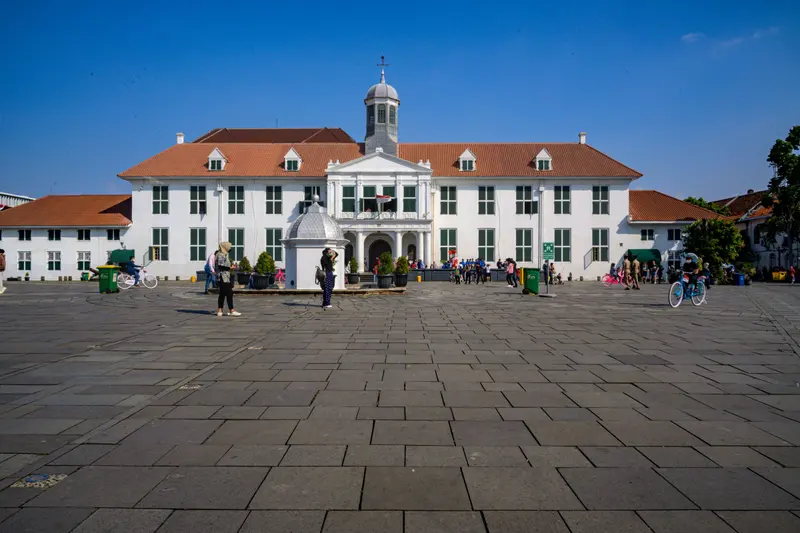
Cafe Batavia on Fatahillah Square, jamu brewed like espresso at Acaraki, Kali Besar's riverside cafés and iced coffee in Glodok.
Photo: Daniel Lee, Pexels License
Kota Tua, the old town, covers about 1.3 km² of North and West Jakarta around Fatahillah Square, the old Nieuwe Markt of Batavia.1 On its south side stands the old Stadhuis, Batavia's city hall, renovated between 1707 and 1710 and a museum of the city's history since 30 March 1974.2 Glodok, where the colonial authorities confined Chinese residents outside the walls after the massacre of 1740, is the Chinatown just to the south.3
Coffee here comes with the setting. Cafe Batavia has the square's northwest corner, Acaraki brews jamu in Gedung Kerta Niaga, and the restored banks of the Kali Besar have Babah Koffie and Cafe Compagnie.45 In Glodok, a tea house sets out free tea at its door, and Kopi Es Tak Kie has served iced coffee since 1927.67
Local tip: Have an iced coffee at Kopi Es Tak Kie in Gang Gloria before 11:00, then walk to Jalan Pancoran for a free cup of green tea from the eight pots outside Pantjoran Tea House.
Nothing matches those filters here. See all cafés in Jakarta.
Jakarta Kota station, rebuilt in 1926–1929 to a design by Frans Ghijsels and opened on 8 October 1929, is the terminus of the KRL Bogor and Tanjung Priok lines. Transjakarta Corridor 1 runs from its Kota stop south to Blok M.8 Kopitiam 88 on Jalan Kusuma I opens earliest in the area, 06:00–14:00 daily, and New Batavia Cafe stays open until 23:00 on weekends.
Cafe Batavia is the second-oldest building on the square after the Stadhuis, a two-storey building finished around 1837 with a wooden gallery upstairs. It served as a residence, an office of the Dutch governors and a warehouse. Graham James, an Australian, bought it in 1990, when it was the only freehold property on the square, restored it in 1992–1993 and opened a restaurant decorated in a 1930s style.4
The upstairs Grand Salon seats 150 behind tall shuttered windows over the square; the ground floor has a bar, a lounge and a stage. In 1996 Newsweek International named its Winston Churchill bar the best in the world.4 The entrance is at Jalan Pintu Besar Utara No. 14.
Acaraki opened in 2018 in Gedung Kerta Niaga, in a narrow alley at Jalan Pintu Besar Utara No. 11.59 Its founder, Jony Yuwono, wanted to win young drinkers back to jamu, the bitter herbal tonic long sold on the street by mbok (women vendors), so the café prepares it with coffee equipment: French press, V60 pour-over and espresso machine.9
The core jamu are beras kencur (rice and kencur root) and kunyit asam (turmeric and tamarind). Saranti blends jamu with milk and sugar, hot or iced, and Golden Sparkling tops kunyit asam with soda. In 2018 the café opened daily 10:00–22:00.5
The Kali Besar was Old Batavia's original river, and between 1900 and 1942 the mansions and shops on its banks became offices.1 A 600-meter stretch along Jalan Kali Besar Timur and Jalan Kali Besar Barat was cleaned up and reopened as a riverside park in July 2018, modeled on Seoul's Cheonggyecheon.10
Babah Koffie by Kawisari, at Jalan Kali Besar Barat No. 28, pairs Peranakan tiles and antique cabinets with Kawisari coffee and kue basah (traditional cakes) such as nona manis, pandan cake with a coconut center, and kue lumpur.11 Cafe Compagnie is at No. 50. The food park at Taman Intan, on Jalan Cengkeh, has Kopi Bugis Toraja Sulawesi Selatan.
Pantjoran Tea House stands on a corner of Jalan Pancoran, an octagonal two-storey building that opened in 1928 as the Chung Hwa pharmacy and became a tea house in 2016. Out front, eight pots of green tea sit on a long table for anyone passing, a custom called patekoan that goes back to Captain Gan Djie, head of Batavia's Chinese community in the 17th century, and his wife.6 Staff refill the pots five or six times a day.6
Gang Gloria, which with Petak Sembilan and Jalan Pancoran makes up Glodok's three main Chinatown areas, is home to Kopi Es Tak Kie.3 At Jalan Pintu Besar Selatan III No. 4–6, it serves black coffee or kopi susu, iced or hot, with a choice of stronger Padang or medium Lampung beans; in 2022 it opened at 06:00 and closed at 14:00.7 CNN Indonesia advised arriving before 11:00.12
In Kota Tua & Glodok, also browse: Specialty coffee Wi-Fi Outdoor seating Open late
Cafe Batavia occupies a two-storey building on the northwest corner of Fatahillah Square, finished around 1837 and the square's second-oldest after the old city hall. It served as a residence, a Dutch governors' office and a warehouse. Graham James, an Australian, bought it in 1990, restored it in 1992–1993 and opened it with 1930s-style decor.
Acaraki is a jamu café that opened in 2018 in Gedung Kerta Niaga, off Fatahillah Square in Jakarta's Kota Tua. Founder Jony Yuwono brews the herbal tonic with coffee equipment, using a French press, a V60 and an espresso machine. The menu centers on beras kencur and kunyit asam, plus milky and sparkling jamu drinks.
Pantjoran Tea House on Jalan Pancoran in Glodok, Jakarta's Chinatown, sets eight pots of green tea on a table outside for passersby, refilled five or six times a day. The custom, patekoan, goes back to Captain Gan Djie, a 17th-century head of Batavia's Chinese community, and his wife. The building opened in 1928 as a pharmacy.
Free listings are free for good. A featured page gives you photos, a menu and your own URL, in your café's own design, for less than a coffee a day.