bambule. Kaffeebar
- Vegetarian options
- Partial wheelchair access
- Smoke-free indoors
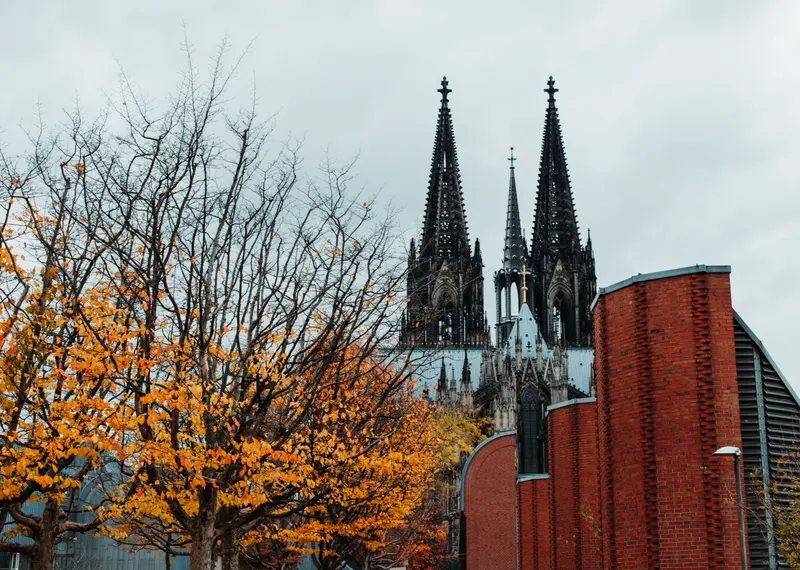
Pilgrims' coffee sheds by the Kalker Kapelle, a café in the Köln Arcaden, Villa Kalka and vegan brunch on Dillenburger Straße.
Photo: Jimmyk photos, Pexels License
Kalk sits on the right bank of the Rhine, walled off from Deutz by a railway embankment.1 A deed of 1003 calls it Villa Kalka or Calke, probably from the Middle High German Kolk, a wet hollow, though some trace it to the lime the Romans may have stored here.1 It grew into a prosperous factory town, joined Cologne on 1 April 1910, was 90 percent destroyed in the Second World War and since the plant closures of the 1970s has turned to homes and offices.1
Kalker Hauptstraße and Kalk-Mülheimer Straße have the most cafés. Robertstraße, Taunusstraße and Waldecker Straße come next, with smaller neighborhood cafés and tea rooms.
Local tip: Pair a film at the Lichtspiele Kalk with a meal at Villa Kalka on the same street: the evening menu starts at 16:00, and the kitchen stays open until 21:00 from Tuesday to Saturday.2
Nothing matches those filters here. See all cafés in Cologne.
Kalk's coffee trade began with a chapel. The Kalker Kapelle was built in 1666–67 in thanks that the plague had spared the village, and its wooden Madonna drew pilgrims.1 After 1815, farmhands who had lost their wages set up wooden sheds along the pilgrims' path selling coffee, tea and hot water; elegant coffeehouses with gardens, grottoes and animal pens followed for Cologne's merchant families, and from the mid-1860s two coffeehouse owners ran horse-drawn omnibuses out from the city.1
The chapel was bombed in 1941 and rebuilt in brick by Rudolf Schwarz and Karl Wimmenauer in 1948–50, beside the neo-Gothic church of St. Marien.1 Stadtbahn lines 1 and 9 run under Kalker Hauptstraße, and the S12 and S19 stop at Trimbornstraße.1 Mi Cafecito, at No. 252, sets out tables in front and closes on Tuesdays.
The first factories went up on the western Hauptstraße from 1856, among them the chemical works of Vorster & Grüneberg, later the Chemische Fabrik Kalk.1 Its 43.6-meter water tower of 1904 now stands at the center of the Köln Arcaden, a mall of 130 shops that opened on 3 March 2005 at Kalker Hauptstraße 55.1
Chocolate Dream shares that address and runs sister cafés in Düsseldorf and Frankfurt; it sells pralines and brownies and serves breakfast, pancakes and salads with its coffee.4 When the Stadtbahn tunnel opened in August 1980, the street was cut from four lanes to two and the sidewalks were widened.1 Eis-Café Friuli, at No. 196, has tables on that sidewalk and closes on Mondays.
The Lichtspiele Kalk reopened in December 2017 in the rooms of the old Union-Lichtspiele, closed in 1974.1 It is the only cinema on Cologne's right bank, and most films run in the English original or with English subtitles.5
At No. 58, Villa Kalka buys its coffee from the Rösterei Ernst in the Südstadt and pours organic Kölsch from the Hellers brewery.2 Its team of baristas, cooks and pastry chefs keeps the daytime menu short for seminar guests and nearby offices, and from 16:00 the evening menu travels through the cuisines of Kalk's mixed population.2 Café International is at No. 12 and Bar La Perla at No. 46.
The Imperial post office, a neo-Gothic building of 1889–90, stands on what was then Corneliusstraße and is now Robertstraße, and a monument to the workers of the chemical factory went up in the small park in front of it in 1908.1 Many guest workers stayed in Kalk, and the share of foreign residents rose from 30.2 percent in 1985 to 40.9 percent in 2000.1 Bodrum and Üsküdar are side by side at Robertstraße 5 and 7.
To the north, the 2.8-hectare Bürgerpark Kalk was laid out between 2006 and 2009 on part of the old chemical works.1 On Dillenburger Straße, Hempies, a fully vegan Cologne bistro, opened in the Machwerkhaus at No. 87 with brunch, lunch specials and coffee on weekdays.3 bambule. Kaffeebar on Wiersbergstraße opens on Sunday afternoons as well, from 14:00.
In Kalk, also browse: Outdoor seating Bakery cafés & Konditoreien Vegan & vegetarian Open late
Kalker Hauptstraße, with Chocolate Dream at the Köln Arcaden and Eis-Café Friuli, and Kalk-Mülheimer Straße, with Villa Kalka and Café International, have the most. Robertstraße, Taunusstraße and Waldecker Straße follow with smaller neighborhood cafés and tea rooms.
Villa Kalka at Kalk-Mülheimer Straße 58 serves coffee from the Rösterei Ernst in Cologne's Südstadt and organic Kölsch from the Hellers brewery. After 16:00 its evening menu draws on the cuisines of Kalk's mixed population.
After 1815, former farmhands built wooden sheds along the pilgrims' path to the Kalker Kapelle and sold coffee, tea and hot water. Elegant coffeehouses with gardens followed for Cologne's merchant families, and two coffeehouse owners ran horse-drawn omnibuses from the city.
Free listings are free for good. A featured page gives you photos, a menu and your own URL, in your café's own design, for less than a coffee a day.