Corazón de México Cafe
- Bubble tea
El Nevado's 1945 ice-cream counter on Avenida Azcapotzalco, cafés near Jardín Hidalgo and on Calzada Azcapotzalco–La Villa.
Photo: Israel Torres, Pexels License
Azcapotzalco is one of Mexico City's 16 alcaldías, in the northwest of the capital.1 The name is Nahuatl for "in the anthill", from a myth in which Quetzalcóatl turned into an ant to carry maize up from the underworld, and locals still call themselves chintololos.14 Founded as a Tepanec altépetl (city-state) in the late 13th century, it controlled the whole Valley of Mexico under Tezozómoc in the early 15th, until Texcoco and the Mexica defeated his son Maxtla.1
Avenida Azcapotzalco, which runs through the old center, has the most cafés. Calzada Azcapotzalco–La Villa and Avenida 22 de Febrero come next, with pairs on Calle Mina and Miguel Lerdo de Tejada and single cafés scattered across the old barrios.
Local tip: Take Line 6 to Camarones for El Nevado at Avenida Azcapotzalco 591 and order the pan de naranja: some customers buy the loaf whole to take abroad.3
Nothing matches those filters here. See all cafés in Mexico City.
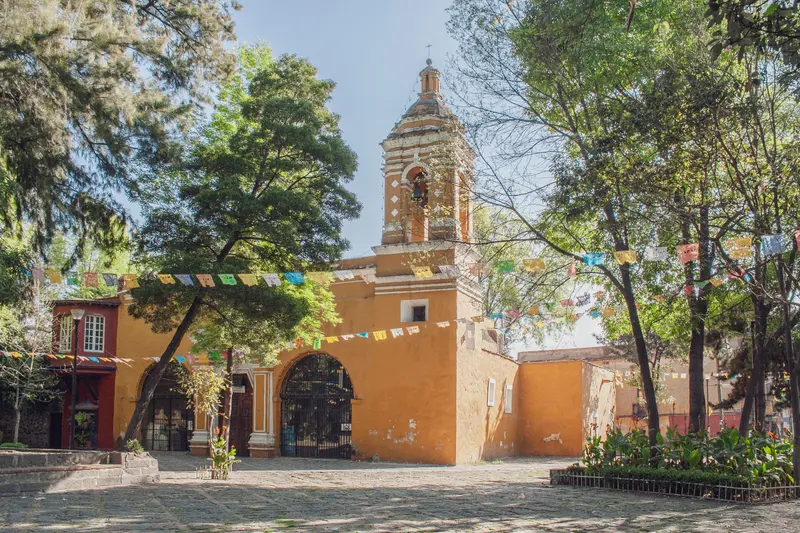
The center of the alcaldía is Jardín Hidalgo, where danzón concerts and classes fill the weekends.1 Facing it, the Casa de Cultura occupies part of the Dominican convent of the parish church next door, with a stairway mural that runs from the Tepanecs to the chintololos.2 In pre-Hispanic times the Tepanec ceremonial center stood on the same site.5
On 19 August 1821 the last battle of the War of Independence was fought in what is now the church's atrium, and a small plaque on its wall along Avenida Azcapotzalco records it.1 A few steps away, Café Eskaparat sits in the Pasaje Reforma, at Aztecas 15, and Mercado Azcapotzalco has 532 stalls, among them stands selling candles, powders and amulets for brujería (folk magic).2
El Nevado, at Avenida Azcapotzalco 591, began as a paletería (ice-pop shop) in 1945 and became one of the alcaldía's best-known cafés, with ice cream from its own factory.3 The story goes that the area's first television set was installed there.3 Time Out sends readers for the pan de naranja (orange bread), the copa suiza with four scoops, and the house flan.3
The same avenue has Café El Tintanismo at No. 451, Cafe Ahura Mazda at No. 514 and Segundo Piso Live at No. 608. Out on Calzada Azcapotzalco–La Villa, Corazón de México Cafe at No. 408 serves bubble tea and opens 08:00–21:00 on weekdays and 10:00–20:00 at weekends, and Balam Cafe-Restaurant is at No. 232.
The local dish is the petrolera: a sope-like base of corn masa fried golden in lard and topped with refried beans, red or green salsa, shredded quesillo and meats from suadero to scrambled egg.4 El Dux de Venecia, in the center, was the third cantina to register in the city, in 1918.2
Clavería is known for its tree-lined avenues and old-style cafés serving pan dulce and café lechero, coffee with plenty of milk.4 The singer José José grew up in Azcapotzalco, and a statue of him stands in Clavería's Parque de la China.41 Nicos, a restaurant that cooks 19th-century recipes such as sopa seca de natas, has been in the colonia since 1957.2
Metro Lines 6 and 7 meet at El Rosario, in the north of the alcaldía, and Time Out gives Camarones on Line 6 as the station for El Nevado.13 Parque Tezozómoc, designed by landscape architect Mario Schjetnan, recreates the Valley of Mexico: its hills were built from earth dug out for Line 6, and its central lake, where you can rent boats, echoes Lake Texcoco.21
The older barrios keep their own churches. San Mateo Xaltelolco, one of 27 barrios defined in 1709, celebrates its patron on 21 September, and La cafetería de bruno fm is on Calle San Mateo, at No. 63.1 On Avenida Cuitláhuac, the Foro Cultural Azcapotzalco opened in 1950 as the Cine Virginia Fábregas and was restored in 2008; Becuadro Café is on the same avenue, at No. 499.1
In Azcapotzalco, also browse: Bakery cafés
El Nevado, at Avenida Azcapotzalco 591, began as an ice-pop shop in 1945 and is one of the alcaldía's best-known cafés. It is known for its pan de naranja, the copa suiza with four scoops of its own ice cream, and its flan.
Avenida Azcapotzalco, through the old center past Jardín Hidalgo, has the most, including El Nevado and Café El Tintanismo. Calzada Azcapotzalco–La Villa and Avenida 22 de Febrero come next.
Lines 6 and 7 serve the alcaldía and meet at El Rosario. Camarones on Line 6 is the station for El Nevado and the center around Jardín Hidalgo.
Free listings are free for good. A featured page gives you photos, a menu and your own URL, in your café's own design, for less than a coffee a day.