Aux Delices Normands
- Vegetarian options
- Partial wheelchair access
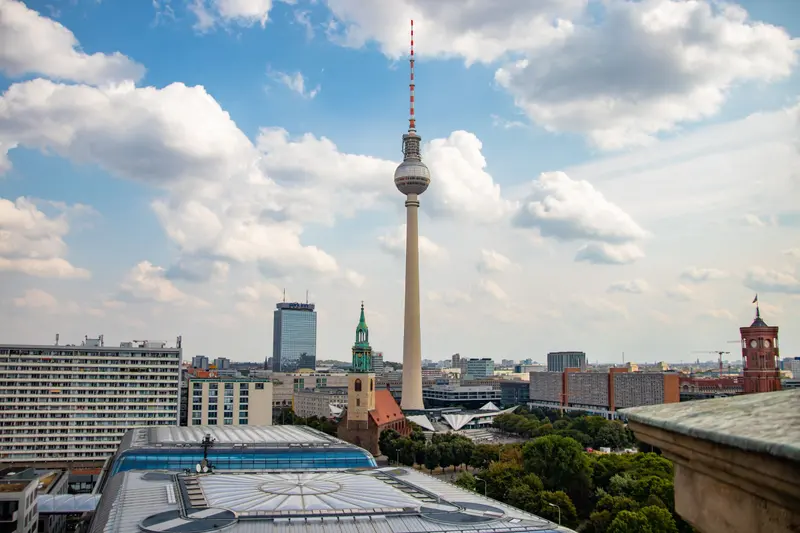
Coffee by Berlin's oldest palace, cake in a museum café, glasshouse breakfasts and Königin-Luise-Straße by the U3.
Photo: Viesturs Davidčuks, Pexels License
Dahlem is a quiet district of villas, institutes and museums in Steglitz-Zehlendorf, with 16,670 residents on 8.39 km² at the end of 2025.1 The Prussian state bought the village in 1841, and a law of 25 March 1901 began carving its estate into a villa colony: buyers had to put up a villa-style house within two years, and by 1915 the population had grown from 194 to 5,500.1 Grunewald, to the north, grew from 1889 on forest land the state sold after Bismarck intervened.4
Königin-Luise-Straße has the most cafés, around Dahlem-Dorf station. The rest are spread thin: a few on the university streets around Thielallee, Ihnestraße and Arnimallee, and single addresses inside museums, a garden center and a hunting palace on the forest edge.
Local tip: For the Kunsthaus café, take bus 115 or X10 to the Brücke-Museum/Kunsthaus Dahlem stop; the signposted walk from there is about 450 m.16
Nothing matches those filters here. See all cafés in Berlin.
Dahlem-Dorf station opened on 12 October 1913, and its entrance is a thatched half-timbered house: Kaiser Wilhelm II wanted it to match the rural look of the Domäne Dahlem estate across the road.3 The Domäne, at Königin-Luise-Straße 49, is now an organic farm and museum with free entry to the grounds, reached by the U3 or buses 110, M11 and X83.13
Its organic market has run for 35 years, with certified producers from Berlin and Brandenburg selling bread, cheese, meat and vegetables in the farmyard on Saturdays from 08:00 to 13:00.12 The cafés sit close together on the same street: Oliv'chen at No. 38 opens daily at 06:00 and has Wi-Fi, Baci's Coffee at No. 39 has outdoor tables, and the organic bakery BioBackHaus is at No. 43.
The Dahlem museum complex is home to the Museum Europäischer Kulturen, while the ethnological collections that once filled it have been shown in the Humboldt Forum since 2021.1 Inside the museum, at Arnimallee 23, the BlümchenKAFFEE! serves coffee and homemade cakes Thursday to Sunday, under a wall hung with a carpet of crocheted, knitted and embroidered flowers made by 10,000 people and arranged by the artist Ursel Arndt.11 Knitters meet there on Thursdays from 14:00.11
eßkultur has run the museum catering in Dahlem since 2001, and now cooks lunch for museum visitors and outside guests in a basement restaurant.10 Around the Freie Universität buildings, CoffeeCross is on Thielallee at No. 34, Pi Cafe on Fabeckstraße, and the French bakery Aux Delices Normands on Ihnestraße.
Peter Joseph Lenné founded the Royal Gardeners' Teaching Institute in Potsdam in 1823, and in 1903 it moved to Dahlem into what was then a modern glasshouse complex.9 The Königliche Gartenakademie on Altensteinstraße now sells plants and runs a garden school there, and its café serves cake in the historic glasshouses, breakfast until 12:00 and a mostly vegetarian and vegan weekly menu built on produce from Berlin and its surroundings.8
On Podbielskiallee, the Eierschale traces its roots to a 1950s West Berlin jazz cellar at Breitenbachplatz and moved into the Landhaus Dahlem in 1977, with concerts and a Sunday jazz morning.7 It reopened on 1 June 2008 after a long closure; in 2026 its Sunday brunch costs €20.90 without drinks, and the terrace has 60 seats.7
Elector Joachim II laid the foundation stone of the Jagdschloss Grunewald on 7 March 1542, and it is the oldest surviving palace building in Berlin.2 It stands on the southeast shore of the Grunewaldsee and has held the city's largest Cranach collection, about 30 works, since 2011.2 Its café is a bistro run by Mosaik for walkers and palace visitors, and the menu includes snacks for dogs.5
Further south, the Kunsthaus Dahlem occupies the former state studio of the Nazi sculptor Arno Breker, built from 1939 to 1942 to designs by Hans Freese.14 The team around Gerald Greh moved its café here in 2018 from the Georg Kolbe Museum and serves homemade cakes, soups and old German dishes under ceilings more than 10 meters high, or on a terrace by the forest.6
The Grunewald villa colony, home to 11,144 people in 2025, took shape at the western end of the Kurfürstendamm and became a municipality of its own on 15 August 1898.4 Wiener Conditorei Caffeehaus am Hagenplatz is one of three branches and makes its cakes by hand from old house recipes, without semi-finished products.15 It opens daily at 07:30 and has outdoor tables.
In Dahlem & Grunewald, also browse: Outdoor seating Vegan & vegetarian Wi-Fi Open by 6am
Königin-Luise-Straße, around the U3 station Dahlem-Dorf, has the most: Oliv'chen at No. 38 opens daily at 06:00, Baci's Coffee at No. 39 has outdoor tables, and BioBackHaus is at No. 43. The Domäne Dahlem farm and museum is on the same street.
Yes. The Jagdschloss Grunewald, built from 1542 on the Grunewaldsee and the oldest surviving palace building in Berlin, has a bistro café run by Mosaik for walkers and palace visitors.
The BlümchenKAFFEE! inside the Museum Europäischer Kulturen at Arnimallee 23 serves coffee and homemade cakes Thursday to Sunday. On the forest edge, the café in the Kunsthaus Dahlem serves cakes and soups under ceilings more than 10 meters high.
Free listings are free for good. A featured page gives you photos, a menu and your own URL, in your café's own design, for less than a coffee a day.