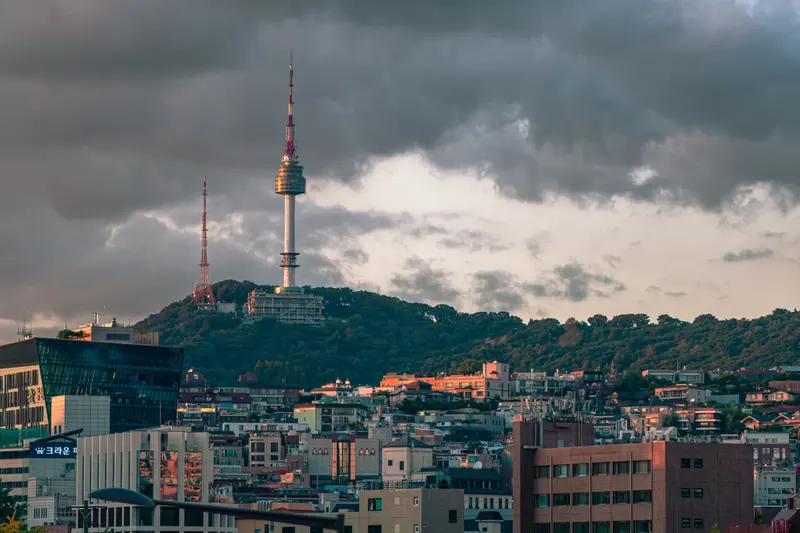
Seoul · Buam-dong
Cafés in Buam-dong
Club Espresso by Changuimun since 2001, a terrace over the city wall, and cafés near Seokpajeong and the Whanki Museum.
Photo: Constantine Kim, Pexels License
Buam-dong (부암동) lies between Inwangsan and Bugaksan, north of Gyeongbokgung, and takes its name from a rock about 2 m high called 부침바위 (buchim bawi, "sticking rock"), written 付岩.1 The legend held that if you rubbed a pebble against it once for every year of your age and it stuck when you let go, a son would follow.1 Renamed Buam-jeong under colonial rule in 1936, it got its old name back in October 1946 and joined Jongno-gu in 1975.1
Being next to the old presidential compound kept it low: military protection and green-belt zoning mean few new buildings and almost nothing tall, and no rail line reaches the neighborhood.1 Changuimun-ro has the most cafés, from the gate up toward the Bugak Skyway, followed by the Baekseokdong-gil lanes and Jahamun-ro, the main road that runs north to Segeomjeong. Several more sit in house lots with only a Buam-dong lot number for an address.
Local tip: There is no subway stop in Buam-dong: from exit 3 of Gyeongbokgung station on Line 3, take green bus 7022, 1020 or 7212 to the Buam-dong Community Center stop, and the Whanki Museum is a seven-minute walk up the road that turns off in front of Club Espresso.9
At a glance
19Cafés listed
0With opening hours
–Earliest opening
–Latest closing
- Most listed streets: Buam-dong (5), Changuimun-ro (2).
- Most common features: specialty (5%).
Jedo
Lumberjack
Per Te 뻬르떼
soon1958
다움 223.1
Daum 223.1
뤼도 발루즈
Rwido Ballujeu
몽유도원
Mongyudowon
부암동 도이창커피
Buamdong Doichang Coffee
성곽마을삼층까페
Seonggwakmaeulsamcheung Cafe
야드esp
우드사이드커피
Udeusaideu Coffee
제비꽃다방
Jebikkot Dabang
카페 무네
Cafe Mune
카페스탐티쉬
Café Stammtisch
카페코나퀸즈 청하점
Cafe Konakwinjeu Cheongha Branch
클럽 에스프레소
Club Espresso
포스트디셈버
Poseuteudisembeo
창의문뜰
Changuimuntteul
Nothing matches those filters here. See all cafés in Seoul.
Coffee chains in Buam-dong
Chain
Mega MGC Coffee 메가커피
Changuimun, the gate on the pass
Changuimun (창의문), also called Jahamun, was finished with the city's other gates in September 1396 and shut in 1413, after a geomancer warned that leaving it open would bring misfortune on the palace.2 Rebel troops marched through it on the night of the 1623 coup that put King Injo on the throne, and its gate tower, built in 1741, is the only one of Seoul's four minor gates still standing.2
Changuimun-ro climbs from the gate past most of the neighborhood's cafés. 뤼도 발루즈 (Ludo Balouze), at No. 142-1, has a terrace that looks down over the city-wall path, and an Esquire Korea walk from April 2026 from Seochon to Hyehwa stopped there for coffee.8 Lumberjack at No. 151 and Coffee SomA at No. 155 are a little higher up the same road.
Club Espresso, a roaster from 1990
클럽 에스프레소 (Club Espresso), at Changuimun-ro 132, opened on Daehak-ro in 1990, serving espresso when it was still unfamiliar in Seoul, and moved to Buam-dong in 2001.6 A 2012 city report credited its owner, Ma Eun-sik, with opening Korea's first coffee academy, and the shop then stocked coffee from 35 countries, with labeled tasting pots lined up by the window.6
In February 2026 Esquire Korea called it a 35-year-old shop run by a first-generation Korean barista and a place of pilgrimage for young people training to make coffee.5 It stands where the Bugaksan road begins beside Changuimun, is not easy to reach by public transport and has no parking of its own.5 The beans go home too: as of 2026 the house Moon blend is listed at ₩12,000 and drip bags at ₩2,000 each.7
Seokpajeong and the regent's villa
Seokpajeong (석파정) began as the Samgyedong villa of the official Kim Heung-geun.3 Heungseon Daewongun, the regent, wanted it; when Kim refused to sell, he came to stay one night with his son, King Gojong, and because a subject could not go on living where the king had slept, the house passed to him.3 He even took the pen name Seokpa (石坡, "stone slope") from the rocky hills around it.3
After the Korean War the villa served as an orphanage and changed owners several times; in January 2006 Ahn Byung-kwang, chairman of the drug distributor Union Pharm, bought it at auction and opened the private Seoul Museum at its entrance.3 As of 2026 a combined ticket costs ₩20,000 for adults, Seokpajeong cannot be visited on its own, and both open Wednesday to Sunday, 10:00–18:00, with last entry at 17:00.11
Baekseokdong-gil and the Whanki Museum
Buam-dong grew out of separate hamlets, among them Mugye-dong, Samgye-dong and Baekseok-dong, the last kept in the name of Baekseokdong-gil.1 In the hills of the same dong, Baekseokdongcheon (백석동천) holds the foundations, pond and inscribed rocks of a 19th-century villa garden once owned by Hong U-gil; it was named for the valley's white stones and became Scenic Site No. 36 in 2008.4 On the lane, 카페스탐티쉬 (Café Stammtisch) is at No. 5, Per Te at No. 11-5 and 야드esp upstairs in the 1ga-gil lane.
The Whanki Museum, at Jahamun-ro 40-gil 63, is devoted to Kim Whanki, the abstract painter, and its annex, finished in November 1993, has an art shop and café on the ground floor.610 Adult admission is ₩13,000 as of 2026, and it closes on Mondays and at Seollal and Chuseok.9 포스트디셈버 (Post December) is on Jahamun-ro 38-gil, at No. 12, and 카페 무네 (Cafe Mune) is on Jahamun-ro itself, at No. 258.
Sources
- 부암동 (서울), Wikipedia (Korean), accessed November 2026
- 창의문, Wikipedia (Korean), accessed November 2026
- 석파정, Wikipedia (Korean), accessed November 2026
- 백석동천, Wikipedia (Korean), accessed November 2026
- 기본 30년 이상 자리를 지켜온 1세대 카페, Esquire Korea, 28 February 2026, accessed November 2026
- 부암동에서 커피 한잔 할까?, Seoul Metropolitan Government (내 손안에 서울), 13 February 2012, accessed November 2026
- Club Espresso online shop, Club Espresso, accessed November 2026
- 서촌 넘어 부암동과 혜화까지, 작가의 전시 후 산책 루틴, Esquire Korea, 30 April 2026, accessed November 2026
- Plan your visit, Whanki Museum, accessed November 2026
- 건축, Whanki Museum, accessed November 2026
- 관람안내, Seokpajeong Seoul Museum, accessed November 2026
Keep exploring
More of Seoul
Seochon
113 cafésSeongbuk-dong
22 cafés
Bukchon & Samcheong-dong
114 cafésIkseon-dong & Insadong
109 cafésHyehwa & Daehak-ro
96 cafés
Euljiro & Chungmuro
120 cafésSeoul Station & Jungnim-dong
31 cafés
Myeong-dong & City Hall
173 cafésGwanghwamun
74 cafésHuam-dong & Haebangchon
84 cafésMangwon-dong
114 cafésYeonhui-dong
58 cafésSinchon & Ewha
113 cafés
Hongdae & Yeonnam-dong
587 cafésGongdeok & Mapo
73 cafés
Itaewon & Hannam-dong
135 cafésYongsan & Yongridan-gil
85 cafés
Seongsu-dong
213 cafésYeouido
53 cafés
Sinsa & Garosu-gil
117 cafés
Apgujeong & Cheongdam
150 cafésSeocho & Seorae Village
96 cafésGangnam & Yeoksam
289 cafésDongdaemun & Sindang-dong
100 cafésWangsimni & Hanyang University
36 cafésKonkuk University & Gunja
108 cafésJangan-dong & Dapsimni
52 cafésAnam & Jegi-dong
66 cafésYongdu-dong & Sinseol-dong
31 cafésHoegi & Imun-dong
67 cafésJunghwa & Myeonmok-dong
13 cafésYeongdeungpo & Dangsan
29 cafésNoryangjin & Sangdo-dong
43 cafésHongje & Hongeun-dong
12 cafésEungam & Gajwa
51 cafésYeonsinnae & Bulgwang
51 cafésPyeongchang-dong
18 cafésGireum & Mia
62 cafésWolgye & Gongneung
65 cafésSangbong & Mangu
79 cafésJunggok & Yongmasan
43 cafésGuui & Gwangnaru
57 cafésJamsil & Seokchon Lake
135 cafésYangjae & Dogok
100 cafésBangbae-dong & Sadang
105 cafésSillim & Nakseongdae
89 cafésGuro & Gasan Digital Complex
28 cafésMullae-dong & Sindorim
68 cafésMok-dong
34 cafésYangpyeong & Seonyudo
15 cafésSangam & DMC
20 cafésIn Buam-dong, also browse: Specialty coffee
FAQ
Buam-dong cafés: questions
How do you get to the cafés in Buam-dong, Seoul without a car?
No rail line reaches Buam-dong. From exit 3 of Gyeongbokgung station on Line 3, green buses 7022, 1020 and 7212 stop at the Buam-dong Community Center, close to Club Espresso and the cafés on Changuimun-ro.
What is Club Espresso in Buam-dong, Seoul known for?
Club Espresso opened on Daehak-ro in 1990, when espresso was still unfamiliar in Seoul, and moved to Changuimun-ro 132 in Buam-dong in 2001. Its owner, Ma Eun-sik, is a first-generation Korean barista, and the shop roasts and sells its own beans, including a Moon blend.
Which street in Buam-dong, Seoul has the most cafés?
Changuimun-ro, the road that climbs from Changuimun gate toward the Bugak Skyway, has the most, including Club Espresso, Ludo Balouze with its terrace over the city-wall path, Lumberjack and Coffee SomA. The Baekseokdong-gil lanes and Jahamun-ro come next.
For café owners
Own a café in Buam-dong?
Free listings are free for good. A featured page gives you photos, a menu and your own URL, in your café's own design, for less than a coffee a day.