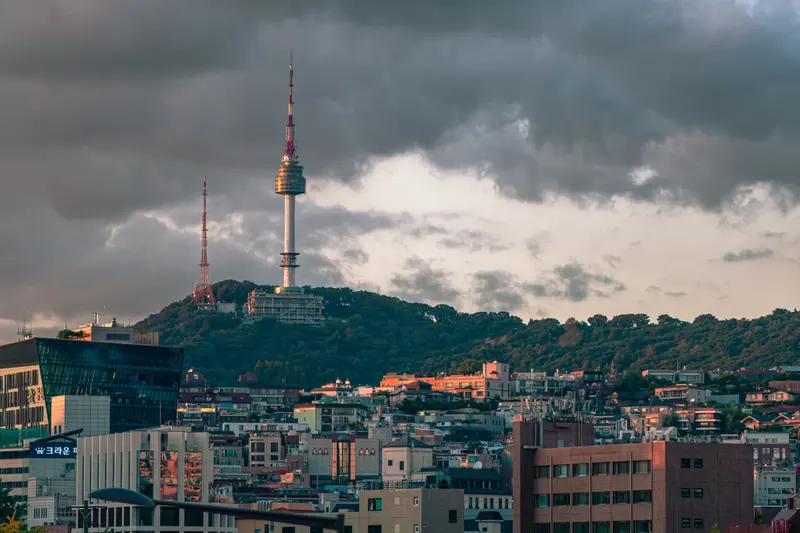
Seoul · Pyeongchang-dong
Cafés in Pyeongchang-dong
Gallery cafés under Bukhansan, Cafe Samiru at the Kim Chong Yung Museum, The Piano above the valley, and Hongjimun gate.
Photo: Constantine Kim, Pexels License
Pyeongchang-dong (평창동) is the northern tip of Jongno-gu, and its name comes from 平倉, a storehouse of the Joseon tax-rice office that stood here; it has nothing to do with Pyeongchang county in Gangwon.1 More than 65% of the dong is green belt, and the land rises from valleys to Bukhansan ridges between 200 and 714 m.1 The Seoul Sarang magazine counts it among the city's best-known wealthy neighborhoods, with galleries and museums down almost every lane.4
Most cafés sit in the numbered Pyeongchang lanes (6-gil, 30-gil, 32-gil, 36-gil) off Pyeongchangmunhwa-ro, the road that crosses the dong from west to east.1 A second group lies to the southwest in Hongji-dong, around Sangmyung University and Hongjimun gate, and a few more are in Gugi-dong toward Bibong.
Local tip: For the SeMA Art Archive at Pyeongchangmunhwa-ro 101, Korea's first public museum devoted to art archives, take bus 1711 from exit 3 of Gyeongbokgung station to the Byeoksan Pyeongchang Hills Apartment stop, or bus 7211 from exit 3 of Gireum station on Line 4 to the Ilsung Apartment stop; entry is free except for special exhibitions, and it closes on Mondays.7
At a glance
18Cafés listed
0With opening hours
–Earliest opening
–Latest closing
Cafe D
Cafe Samiru
lazy
Pine Cone
구기동 비비드
Gugidong Bibideu
유캔두잇
Yukaenduit
카페 클래식
Cafe Classic
카페라파미
Cafe Rapami
카페미고
Cafe Migo
평창동 the piano - 더 피아노
평창동 북악정
Pyeongchangdong Bukakjeong
블루포트 상명대학교
Beullupoteu Sangmyeongdaehakgyo
Gallery Cafe En
LOB
다다
Dada
모네
Mone
스카이 카페
Seukai Cafe
Nothing matches those filters here. See all cafés in Seoul.
Coffee chains in Pyeongchang-dong
Chain
Mega MGC Coffee 메가커피
Chain
Starbucks
Chain
Coffine Gurunaru 커핀그루나루
Gallery EN and the Lee O-young road
Pyeongchang-dong has an honorary street name, Lee O-young-gil, for the stretch from the end of Pyeongchang 30-gil to the Gana Art Center; it honors Lee O-young (1934–2022), whose study can be seen at the Yeongin Literature Museum, opened nearby in 2001.4 Pine Cone, a bakery café, is on the same lane at Pyeongchang 30-gil 27.
Gallery Cafe En takes its name from Elements and Narratives, and coffee there comes in ceramics made by artists.4 Esquire Korea placed it near Gamnamugol Park in 2020: the gallery opened by reservation only, the café took walk-ins off the trail, glasswork filled the room and a terrace led onto a short footpath.6 The menu then ran to drip coffee, black coffee and white coffee.6
Kim Chong Yung Museum and Cafe Samiru
Kim Chong Yung (1915–1982) is regarded as a pioneer of Korean abstract sculpture, and the museum in his name opened in December 2002 at Pyeongchang 32-gil 30, designed to sit quietly against the Bukhansan slope.4 Its main hall shows his work, the newer hall stages exhibitions by younger artists, and admission is free.5
Cafe Samiru, which calls itself the museum's café, shares the address.8 It connects to the galleries but can be visited on its own, and it looks out over the museum garden and the houses of the hillside.4 From exit 3 of Gyeongbokgung station on Line 3, bus 1711 runs to the Lotte Apartment stop, 365 m from the door.5
The Piano, at the top of the valley road
평창동 the piano (더 피아노), at Pyeongchang 6-gil 71, sits at the very top of the road to Pyeongchang valley.6 On a clear day the view runs past Bugaksan to the towers of Yeouido, and the outdoor seats were built around the bare rock, so the valley stream runs right in front of them.6 Esquire Korea's 2020 visit noted cherry blossom in spring and snow on the rock face in winter.6
Television has used the same hillside houses for years: Secret Garden, Coffee Prince and High Kick Through the Roof were among the dramas filmed in Pyeongchang-dong.1 평창동 북악정 (Bukakjeong) is at Pyeongchang 36-gil 6, and the Pyeongchang-dong lots hold 카페라파미 (Cafe Rapami) at No. 99-35 and 카페미고 (Cafe Migo) at No. 229-4.
Hongjimun and Sangmyung University
Hongjimun (홍지문) was built in 1715 as the gate of Tangchundaeseong, the wall that tied the Seoul city wall to the Bukhansan fortress.2 The upper and lower Pyeongchang military granaries stood inside that wall.2 A flood in 1921 washed away the gate and its five-arched water gate; Seoul rebuilt both in 1977, and the signboard was written by President Park Chung-hee.2 카페 클래식 (Cafe Classic) is on Hongjimun-gil, at No. 27.
Sangmyung University began on 1 December 1937 as a women's vocational school and became coeducational in 1996; its Seoul campus is at Hongjimun 2-gil 20.3 A Bluepot café trades on campus, and Cafe Costa and lazy are in the Hongji-dong lots.
Sources
- 평창동, Wikipedia (Korean), accessed November 2026
- 홍지문 및 탕춘대성, Wikipedia (Korean), accessed November 2026
- 상명대학교, Wikipedia (Korean), accessed November 2026
- 발길 닿는 곳곳에 예술 가득, 대체 불가한 평창동의 매력, Seoul Sarang (Seoul Metropolitan Government), 4 January 2024, accessed November 2026
- 김종영 미술관, Visit Seoul (Seoul Tourism Organization), accessed November 2026
- 북악산 뷰 평창동 핫플레이스 갤러리 카페 5, Esquire Korea, 17 November 2020, accessed November 2026
- 서울시립 미술아카이브 방문 안내, Seoul Museum of Art, accessed November 2026
- 김종영 미술관 카페 사미루, Cafe Samiru (Naver Blog), accessed November 2026
Keep exploring
More of Seoul
Seochon
113 cafésBuam-dong
19 cafésSeongbuk-dong
22 cafés
Bukchon & Samcheong-dong
114 cafésIkseon-dong & Insadong
109 cafésHyehwa & Daehak-ro
96 cafés
Euljiro & Chungmuro
120 cafésSeoul Station & Jungnim-dong
31 cafés
Myeong-dong & City Hall
173 cafésGwanghwamun
74 cafésHuam-dong & Haebangchon
84 cafésMangwon-dong
114 cafésYeonhui-dong
58 cafésSinchon & Ewha
113 cafés
Hongdae & Yeonnam-dong
587 cafésGongdeok & Mapo
73 cafés
Itaewon & Hannam-dong
135 cafésYongsan & Yongridan-gil
85 cafés
Seongsu-dong
213 cafésYeouido
53 cafés
Sinsa & Garosu-gil
117 cafés
Apgujeong & Cheongdam
150 cafésSeocho & Seorae Village
96 cafésGangnam & Yeoksam
289 cafésDongdaemun & Sindang-dong
100 cafésWangsimni & Hanyang University
36 cafésKonkuk University & Gunja
108 cafésJangan-dong & Dapsimni
52 cafésAnam & Jegi-dong
66 cafésYongdu-dong & Sinseol-dong
31 cafésHoegi & Imun-dong
67 cafésJunghwa & Myeonmok-dong
13 cafésYeongdeungpo & Dangsan
29 cafésNoryangjin & Sangdo-dong
43 cafésHongje & Hongeun-dong
12 cafésEungam & Gajwa
51 cafésYeonsinnae & Bulgwang
51 cafésGireum & Mia
62 cafésWolgye & Gongneung
65 cafésSangbong & Mangu
79 cafésJunggok & Yongmasan
43 cafésGuui & Gwangnaru
57 cafésJamsil & Seokchon Lake
135 cafésYangjae & Dogok
100 cafésBangbae-dong & Sadang
105 cafésSillim & Nakseongdae
89 cafésGuro & Gasan Digital Complex
28 cafésMullae-dong & Sindorim
68 cafésMok-dong
34 cafésYangpyeong & Seonyudo
15 cafésSangam & DMC
20 cafés
FAQ
Pyeongchang-dong cafés: questions
Which cafés in Pyeongchang-dong, Seoul are inside galleries or museums?
Cafe Samiru is the café of the Kim Chong Yung Museum at Pyeongchang 32-gil 30, where admission to the galleries is free. Gallery Cafe En pairs a gallery with a café whose coffee comes in ceramics made by artists.
How do you get to the cafés in Pyeongchang-dong, Seoul by public transport?
From exit 3 of Gyeongbokgung station on Line 3, take bus 1711 to the Lotte Apartment stop for the Kim Chong Yung Museum and Cafe Samiru.
What is The Piano café in Pyeongchang-dong, Seoul like?
The Piano, at Pyeongchang 6-gil 71, sits at the top of the road to Pyeongchang valley. Its outdoor seats are built around the bare rock beside the valley stream, and on a clear day the view reaches past Bugaksan to Yeouido.
For café owners
Own a café in Pyeongchang-dong?
Free listings are free for good. A featured page gives you photos, a menu and your own URL, in your café's own design, for less than a coffee a day.