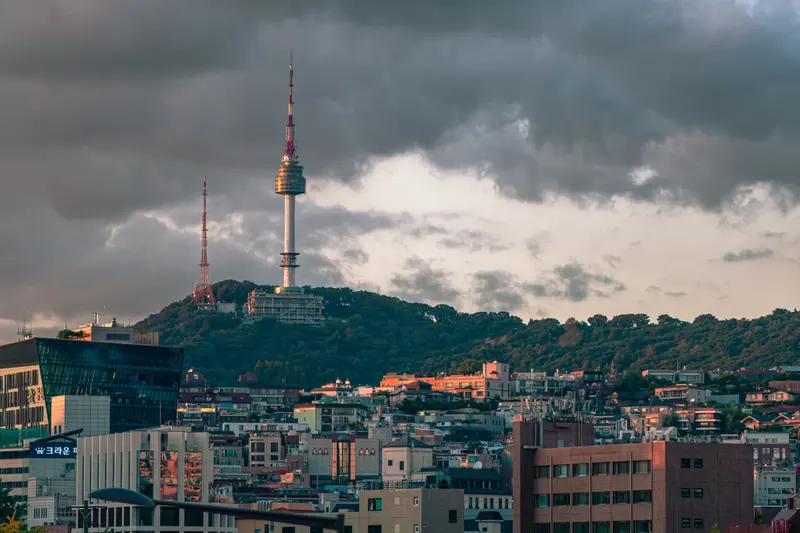
Seoul · Junggok & Yongmasan
Cafés in Junggok & Yongmasan
Coffee along Myeonmok-ro and Sagajeong-ro, a roaster below Achasan and cafés by the Line 7 stops under Yongmasan.
Photo: Constantine Kim, Pexels License
Junggok-dong (中谷洞) got its name from its position halfway between Neung-dong and Myeonmok-dong: villagers called it gandenmal, the middle village.1 The Jungnangcheon stream marks its western edge and Achasan its eastern one, and Line 5 and Line 7 cross here.1 Myeonmok-dong, its neighbor, belongs to Jungnang-gu, and Yongmasan rises behind both.
Myeonmok-ro has the most cafés, from Street 1988 at No. 128 to Coffee Bokneunkkun at No. 305. Sagajeong-ro comes next, followed by Neungdong-ro on the Junggok side and the lanes off Gingorang-ro and Yeonghwasa-ro at the foot of the hills.
Local tip: For the Sagajeong-ro cafés, get off at Sagajeong on Line 7: the station is at Sagajeong-ro 393, a few doors from Line-up Coffee at No. 382 and Seven Monkeys Coffee at No. 390.6
At a glance
43Cafés listed
0With opening hours
–Earliest opening
–Latest closing
- Most common features: specialty (5%), wi-fi (2%).
Byrain
Cafe Oneway
Good Thing Coffee
placemoment 사가정
Seed Nua Junggok Branch
내친구고양이카페
Naechingugoyangi Cafe
니지가하라 虹ヶ原
멜로우파우치 커피로스터스 아차산
Melloupauchi Coffee Roasters Achasan
봄희커피
Bomhui Coffee
시즌-season
오프아이디어
Opeuaidieo
주노샌드
Junosaendeu
카페무호
Cafe Muho
카페트윈즈(Cafe twins)
커피소소데일리
Coffee Soso Daily
커피홍당무
Coffee Hongdangmu
헤르츠커피로스팅
Hereucheu Coffee Roasting
seven monkey's coffee
Seven Monkeys Coffee
그래그릭
Geuraegeurik
단비스튜디오
Danbi Studio
더마실카페
Deomasil Cafe
동네카페
Dongne Cafe
동다방3F
라인업커피
Raineop Coffee
미드나잇선
Mideunaitseon
샵포레스트
Syapporeseuteu
숙이카페
Suki Cafe
스너글리
Seuneogeulli
스트릿1988
Street 1988
아인플라츠
Ainpeullacheu
안방다방
Anbang Dabang
와플샵
Wapeulsyap
정이네커피상점
Jeongine Coffee Sangjeom
차차
Chacha
Nothing matches those filters here. See all cafés in Seoul.
Coffee chains in Junggok & Yongmasan
Chain
Mega MGC Coffee 메가커피
Show 12 locations
Chain
Starbucks
Chain
Ediya Coffee 이디야커피
Chain
A Twosome Place 투썸플레이스
Chain
Paik's Coffee 빽다방
Chain
Compose Coffee 컴포즈커피
Chain
Tom N Toms 탐앤탐스
Chain
Caffé Bene 카페베네
Junggok and Neungdong-ro
The flatland here has long been worked. A 1918 survey counted 118 Baekje stone-chamber tombs in the area, and in the Joseon era the king came to plow fields here in person, with a royal horse pasture nearby.1 Gwangjin-gu's own history adds that the state raised and trained military horses in what is now the district, and kings came out to watch the drills.8
Modern Junggok is younger. Neungdong-ro opened in 1978 as Junggok-ro, and Junggok station on Line 7 followed in 1996.1 Cafe Twins sits at Neungdong-ro 378, Waffle Shop at No. 400 and MV Lab, which bills itself as an AI robot café, at No. 443, while Cafe Bongbong and Danbi Studio share the 50-gil lane.
Yongmasan and the Achasan ridge
Yongmasan, at 348 m the highest peak of the Achasan range, straddles Junggok-dong and Myeonmok-dong; its name, "dragon horse mountain", comes from a legend that a yongma once emerged from it.7 Gingorang, the valley that runs down from the peak, was called gin-gol, the long valley, because of its length.7 Until the mid-Joseon period the slopes were pasture with few houses, and tigers and wolves lived here, which made it a royal hunting ground.2
Gwangjin-gu's course 3 runs from the meeting plaza past Goguryeojeong pavilion to the Achasan summit and on to the Yongmasan summit, about two and a half hours on foot.3 Below the slopes, Mellow Pouch Coffee Roasters Achasan is in Yeonghwasa-ro 9-gil and Good Thing Coffee at Yeonghwasa-ro 51; Coffee Hongdangmu and Chacha sit in the Gingorang-ro lanes.
Sagajeong and Myeonmok-ro
Sagajeong station, opened on 11 October 1996, takes its name from the pen name of Seo Geo-jeong, a Joseon scholar-official who built a pavilion near Yongmasan and planted the plum, bamboo, lotus and rugosa rose he loved around it.6 It sits 0.8 km from Yongmasan station and 0.9 km from Myeonmok.6
Along Sagajeong-ro, Line-up Coffee is at No. 382 and Seven Monkeys Coffee, with Wi-Fi, at No. 390, while Hwachaesarang, named after hwachae (화채, a fruit punch), is at No. 423-2. On Myeonmok-ro, Shop Forest is at No. 222, Juno Sand on the second floor of No. 278 and Coffee Soso Daily in the 27na-gil lane. The cat café Naechingu Goyangi is at Myeonmok-ro 306.
Low-rise streets due for change
Much of Junggok's housing dates from a 1974 land readjustment, which left dense low-rise homes on narrow roads.4 On 28 September 2026 Seoul's planning committee approved the Junggok 1-dong A redevelopment: up to 35 floors and 2,200 homes, 424 of them rental, within a kilometer of Gunja and Junggok stations.4
The plan adds a walking route along Gingorang-ro down to the Jungnangcheon stream, and Gingorang-ro is to widen from four lanes to five as part of restoring the Gingorangcheon stream.5 Gwangjin-gu itself is only three decades old: it split from Seongdong-gu on 1 March 1995, along the line of the Jungnangcheon and Dongil-ro.8
Sources
- 중곡동, Wikipedia (Korean), accessed November 2026
- 아차산소개, Gwangjin-gu Office, accessed November 2026
- 아차산 코스안내, Gwangjin-gu Office, accessed November 2026
- 광진구 중곡동에 2200가구 들어선다, Seoul Shinmun, 1 October 2026, accessed November 2026
- 중곡동 첫 신통기획 확정⋯최고 35층·2200가구 재개발 본격화, Etoday via Daum, 25 March 2026, accessed November 2026
- 사가정역, Wikipedia (Korean), accessed November 2026
- 아차산, Wikipedia (Korean), accessed November 2026
- 발자취: 역사속의 광진, Gwangjin-gu Office, accessed November 2026
Keep exploring
More of Seoul
Seochon
113 cafésBuam-dong
19 cafésSeongbuk-dong
22 cafés
Bukchon & Samcheong-dong
114 cafésIkseon-dong & Insadong
109 cafésHyehwa & Daehak-ro
96 cafés
Euljiro & Chungmuro
120 cafésSeoul Station & Jungnim-dong
31 cafés
Myeong-dong & City Hall
173 cafésGwanghwamun
74 cafésHuam-dong & Haebangchon
84 cafésMangwon-dong
114 cafésYeonhui-dong
58 cafésSinchon & Ewha
113 cafés
Hongdae & Yeonnam-dong
587 cafésGongdeok & Mapo
73 cafés
Itaewon & Hannam-dong
135 cafésYongsan & Yongridan-gil
85 cafés
Seongsu-dong
213 cafésYeouido
53 cafés
Sinsa & Garosu-gil
117 cafés
Apgujeong & Cheongdam
150 cafésSeocho & Seorae Village
96 cafésGangnam & Yeoksam
289 cafésDongdaemun & Sindang-dong
100 cafésWangsimni & Hanyang University
36 cafésKonkuk University & Gunja
108 cafésJangan-dong & Dapsimni
52 cafésAnam & Jegi-dong
66 cafésYongdu-dong & Sinseol-dong
31 cafésHoegi & Imun-dong
67 cafésJunghwa & Myeonmok-dong
13 cafésYeongdeungpo & Dangsan
29 cafésNoryangjin & Sangdo-dong
43 cafésHongje & Hongeun-dong
12 cafésEungam & Gajwa
51 cafésYeonsinnae & Bulgwang
51 cafésPyeongchang-dong
18 cafésGireum & Mia
62 cafésWolgye & Gongneung
65 cafésSangbong & Mangu
79 cafésGuui & Gwangnaru
57 cafésJamsil & Seokchon Lake
135 cafésYangjae & Dogok
100 cafésBangbae-dong & Sadang
105 cafésSillim & Nakseongdae
89 cafésGuro & Gasan Digital Complex
28 cafésMullae-dong & Sindorim
68 cafésMok-dong
34 cafésYangpyeong & Seonyudo
15 cafésSangam & DMC
20 cafésIn Junggok & Yongmasan, also browse: Specialty coffee Wi-Fi
FAQ
Junggok & Yongmasan cafés: questions
Which streets in Junggok and Yongmasan, Seoul have the most cafés?
Myeonmok-ro has the most, with Street 1988, Shop Forest, Juno Sand and Coffee Bokneunkkun. Sagajeong-ro comes next, with Line-up Coffee and Seven Monkeys Coffee near Sagajeong station, followed by Neungdong-ro on the Junggok side and the lanes off Gingorang-ro and Yeonghwasa-ro.
How did Sagajeong station near Yongmasan in Seoul get its name?
Sagajeong was the pen name of Seo Geo-jeong, a Joseon scholar-official who built a pavilion near Yongmasan and planted plum, bamboo, lotus and rugosa rose around it. The Line 7 station opened in October 1996.
Can you hike Yongmasan from the cafés in Junggok, Seoul?
Yes. Yongmasan is the highest peak of the Achasan range at 348 m, and Gwangjin-gu's course 3 runs from the meeting plaza over the Achasan summit to the Yongmasan summit in about two and a half hours. Mellow Pouch Coffee Roasters and Good Thing Coffee are on Yeonghwasa-ro below the slopes.
For café owners
Own a café in Junggok & Yongmasan?
Free listings are free for good. A featured page gives you photos, a menu and your own URL, in your café's own design, for less than a coffee a day.